






What Is Very Narrow Aisle (VNA) Pallet Racking?
Very narrow aisle pallet racking is a high-density version of adjustable pallet racking in which the access aisles are reduced to the minimum width required by a specialist VNA truck.

What Is Very Narrow Aisle (VNA) Pallet Racking?
Very narrow aisle pallet racking is a high-density version of adjustable pallet racking in which the access aisles are reduced to the minimum width required by a specialist VNA truck. Every pallet can remain directly accessible, but the warehouse uses less floor area for aisles and more for storage. Typical VNA aisles are often around 1.5 to 2 metres wide, compared with roughly 2.8 to 3.5 metres for conventional counterbalance or reach-truck layouts, although the truck manufacturer must confirm the exact dimension.
VNA is not simply standard racking moved closer together. The rack, truck, floor, guidance system, transfer aisle, fire protection and operating process must be designed as one system. It works best in tall buildings with a large number of pallet locations and disciplined stock handling.
Mowbray surveys and designs VNA and other pallet racking layouts across the UK, allowing businesses to compare capacity, cost and operational trade-offs before choosing a system.
VNA is not simply standard racking moved closer together. The rack, truck, floor, guidance system, transfer aisle, fire protection and operating process must be designed as one system. It works best in tall buildings with a large number of pallet locations and disciplined stock handling.
Mowbray surveys and designs VNA and other pallet racking layouts across the UK, allowing businesses to compare capacity, cost and operational trade-offs before choosing a system.
VNA compared with standard adjustable pallet racking
Pallet access - Direct access to every location - Direct access to every location
Aisle width - Wider, truck-dependent - Very narrow, specialist-truck dependent
Truck type - Counterbalance or reach truck commonly used - Turret or dedicated VNA truck
Floor requirement - Normal engineered warehouse floor tolerances - More demanding flatness and level tolerances, especially at height
Storage density - Moderate - High
Flexibility - Easier to change trucks and operating patterns - More dependent on a coordinated system
Initial investment - Usually lower - Usually higher due to trucks, guidance and floor requirements
VNA preserves selectivity better than drive-in racking, which stores pallets several deep. It may therefore suit a wide SKU range and frequent access. Drive-in can achieve higher density for large batches of the same product, but it offers less direct access.
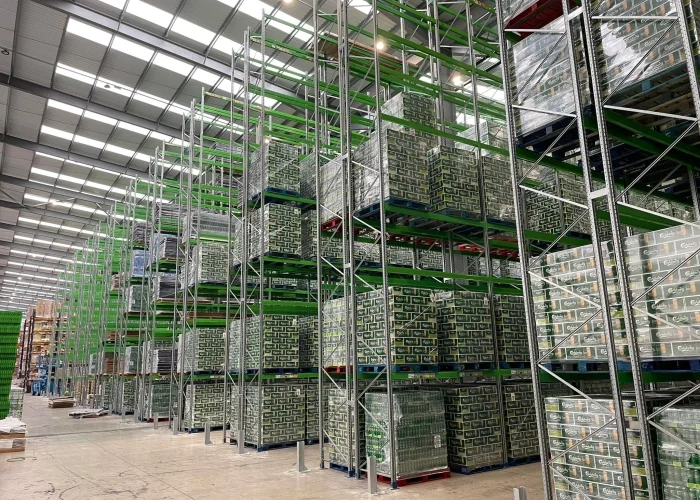
Specialist VNA trucks
The truck is central to the design. Its chassis width, operating clearance, lift height, residual capacity, guidance method and transfer requirements determine the aisle and beam layout. The rated capacity at ground level is not necessarily the capacity available at the top beam, so the load data must be checked at the required lift height. Battery charging, maintenance, rescue procedures and driver training also need space and planning. Some operations use separate feeder trucks to bring pallets to pick-and-deposit stations at the end of each aisle, allowing the VNA truck to remain inside its working zone. Truck procurement should not happen after the racking is ordered. Even small differences in clearance or fork arrangement can affect the approved aisle dimensions.Guidance systems
VNA trucks are commonly guided by floor-mounted rails or an inductive wire system. Mechanical guide rails keep the truck aligned within the aisle and help protect the lower rack, although entry must be designed carefully. Wire guidance uses a signal embedded in the floor that the truck follows electronically. The chosen method affects civil work, rack clearances and maintenance. Guide rails can influence cleaning and pedestrian access. Wire guidance requires accurate installation and protection of the embedded route. Free-ranging operation may be possible with some equipment, but the supplier’s safety and clearance requirements still apply. End-of-aisle slowing, travel control and height-positioning technology can improve performance, but they do not remove the need for trained operators and a managed traffic system.
Floor flatness and level
At high lift heights, a small floor variation can create significant mast movement. VNA floors therefore need suitable flatness and level characteristics along the truck paths. An existing slab may require a specialist survey before the layout is finalised. Local grinding, remedial work or a different aisle position may be needed. The relevant standard and truck supplier define acceptable tolerances for the proposed equipment and height. A visual check is not enough. Racking erected perfectly plumb cannot compensate for a truck travelling on an unsuitable floor. Floor joints, damage and settlement also matter over time. The maintenance plan should include the truck paths as well as the rack structure.Building height and top clearances
VNA is often selected to use vertical space. The top pallet must remain below roof steel, lights, heaters and sprinkler clearances, with enough handling space for safe placement. The truck must retain the required capacity and stability at that level. Rack design considers frame height, slenderness, loads and bracing. Taller systems can increase sensitivity to installation tolerances and impact. Building columns and roof bracing may create breaks in runs or unusable upper positions. A laser survey and detailed section drawing help establish the true storage envelope instead of relying on the nominal eaves height.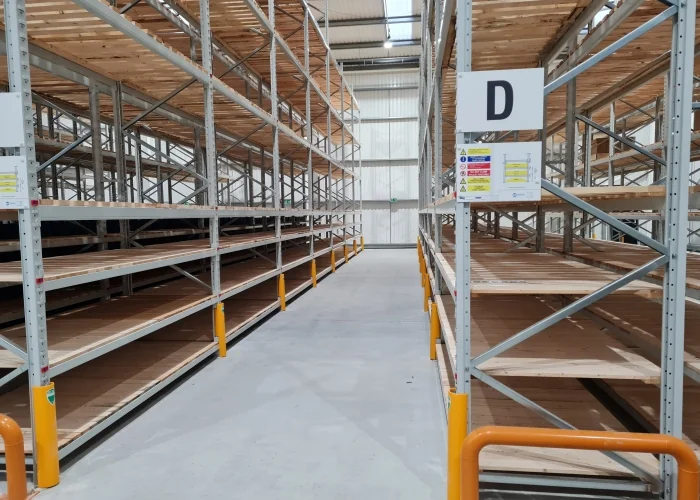
Fire safety and emergency arrangements
Narrow aisles influence escape and firefighting access. The layout must keep required routes clear and coordinate sprinklers, flues and storage clearances. Where operators rise with the truck, rescue procedures are needed for equipment failure or medical emergencies at height. The warehouse fire-risk assessment should reflect the increased storage density and commodity type. More goods in the same building can change fire load and sprinkler demand. Rack layouts may require transverse or longitudinal flue spaces, and those spaces must not be closed by careless pallet placement. Pedestrian access to VNA aisles should be controlled. A person and truck cannot safely share a corridor that was designed only for the machine’s operating envelope.Stock and throughput suitability
VNA works well for a broad SKU range, high pallet count and relatively consistent pallet dimensions. It is often used in distribution, manufacturing and parts operations where direct access matters. It can support batch picking and high-level order picking with the correct truck. The system may be less suitable where pallets are badly damaged, loads overhang unpredictably or stock arrives in many non-standard sizes. It can also create a throughput constraint if too many movements depend on a small number of specialist trucks. Operational modelling should consider movements per hour, peak periods, replenishment, marshalling and truck downtime. Capacity is valuable only if pallets can move through the system at the required rate.
Advantages of VNA racking
The main advantage is more pallet locations without sacrificing direct access. It can postpone a move or extension, reduce travel across a larger building and make better use of high roof space. A controlled aisle can also support precise positioning and stock-location discipline. VNA is scalable where the building allows additional runs, and beam levels can often be adjusted within the approved frame design. It remains a familiar pallet-racking format for inventory management. For businesses paying a high property cost per square metre, the capacity gain can justify specialist equipment and floor work.Limitations and risks
The system requires higher initial investment and is more dependent on specialist trucks. A breakdown can affect access to an entire aisle. Driver training, maintenance and rescue planning are therefore important. Tight clearances leave less tolerance for poor pallets, overhanging loads and damaged rack. Floor quality can be a major constraint in an existing warehouse. The layout may also be less flexible if future operations need wider vehicles or frequent pedestrian access. VNA should be chosen because the whole operation suits it, not only because the plan shows more blue rectangles representing pallets.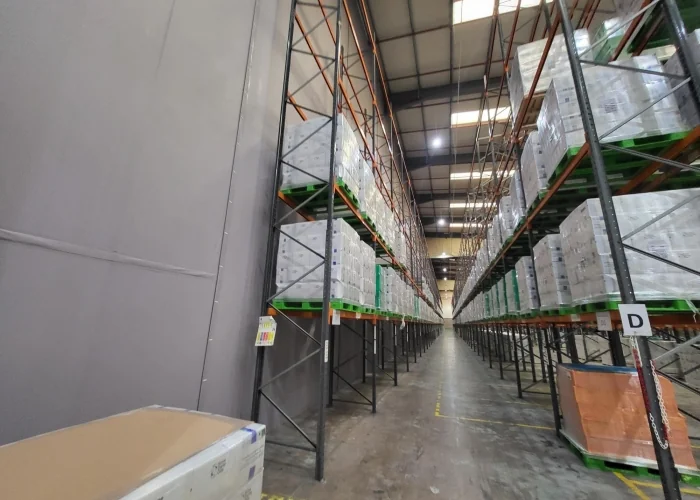
The VNA design process
A survey records the building, slab, services and fire routes. Stock analysis establishes pallet size, weight, SKU count and movement frequency. Potential truck suppliers provide equipment data, and the designer produces layout options with capacity schedules. The preferred option is then checked for rack loads, floor tolerances, top clearances, guidance, protection, pick-and-deposit stations, charging and maintenance access. Installation and commissioning are planned so the rack, truck and guidance system are tested together. Mowbray can coordinate the storage layout with mezzanine, shelving and wider warehouse fit-out work where several systems share the same space.Is VNA right for your warehouse?
VNA is a strong option when the building is tall, floor area is expensive, direct pallet access is required and the operation can support specialist trucks. It is less compelling when stock is low-volume, loads are inconsistent or the slab cannot meet the necessary tolerances without major work. A comparative survey should model standard APR, VNA and any relevant high-density alternatives. The decision can then be based on installed cost, usable positions, throughput and long-term flexibility. Call 01572 827206, contact the Northern Office on 0113 403 1160 or email info@mowbrayltd.co.uk.FAQs
- What does VNA stand for?
VNA stands for very narrow aisle. It describes a pallet-racking layout designed around specialist trucks operating in much narrower aisles than conventional counterbalance or reach-truck systems.
- How wide is a VNA aisle?
Many systems fall broadly around 1.5-2 metres, but the exact width comes from the truck and rack design. Load dimensions, guidance, lift height and safety clearances must be included.
- Can a reach truck operate in VNA racking?
Conventional reach trucks normally need wider aisles and are not a substitute for a dedicated VNA truck. Equipment suppliers should confirm the operating envelope before the rack is designed.
- Does VNA need a special floor?
It needs a floor that meets the flatness and level requirements for the truck and lift height. Existing slabs should be surveyed; local remediation may be required.
- Is every pallet directly accessible?
In a standard VNA selective layout, yes. That is a key advantage over deep-lane systems. Access can still be affected by truck availability and operational controls.
- Is VNA more expensive than standard racking?
The racking and overall system usually cost more because of specialist trucks, guidance, floor checks and commissioning. The business case comes from additional capacity and better use of the building.