






What Is Push-Back Pallet Racking?
A push-back pallet racking system stores pallets two or more positions deep on inclined rails, wheeled carts or rollers.

What Is Push-Back Pallet Racking?
A push-back pallet racking system stores pallets two or more positions deep on inclined rails, wheeled carts or rollers. A forklift places the first pallet on the top cart. Each new pallet pushes the earlier load farther into the lane. When the front pallet is removed, the remaining pallets move forward under controlled gravity, ready for the next collection.
The system is normally operated on a last-in, first-out basis, often shortened to LIFO. Every storage lane is loaded and unloaded from the same aisle face, and a lane is usually assigned to one stock keeping unit or a compatible batch. This gives a warehouse greater pallet density than conventional adjustable pallet racking without requiring the forklift to enter the rack structure.
Push-back racking can be an effective answer where floor space is expensive, several pallets are held per product and strict first-in, first-out rotation is not required. It is not automatically the best dense-storage system for every warehouse. Pallet quality, stock profile, lane depth, load weight, truck operation and maintenance all need to be designed as one system.
Mowbray designs, supplies and installs pallet racking for warehouses and factories across the UK. A measured survey and stock analysis allow the push-back layout to be compared with adjustable, VNA, drive-in, double-deep and other storage options before equipment is ordered.
Main components of a push-back system
A complete installation combines standard racking structure with moving lane equipment. Upright frames transfer the loads to the floor. Beams support the push-back rails or roller beds. Carts, wheels and bearings carry the pallets and allow each load to travel within its allocated position. Stops and centring features help maintain the correct pallet path. The structure also needs floor fixings, load notices, upright protection where risk assessment identifies a need, row spacers in back-to-back arrangements and suitable clearances around sprinklers, walls and building columns. None of these items should be treated as an afterthought. The capacity of a lane depends on the complete assembly, including its anchors and the condition of the slab beneath it. Pallets are part of the operating system too. A damaged, weak or unsuitable pallet may not sit correctly on the carts or rollers. The designer needs accurate information about pallet dimensions, bottom-board arrangement, load overhang, maximum weight and any variation between suppliers.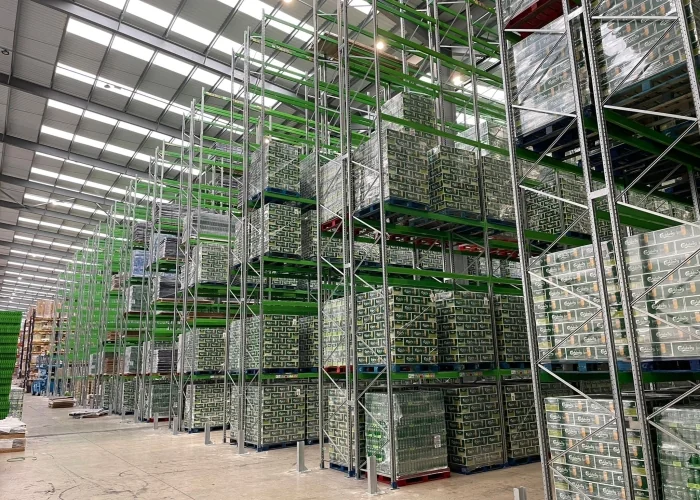
What are the advantages of push-back pallet racking?
More pallets in the same warehouse footprint: Push-back racking reduces the number of access aisles compared with single-deep adjustable racking. Multiple pallets are stored behind one picking face, allowing a larger proportion of the floor to be used for stock. This can postpone a move, release space for production or increase buffer stock within the current building. The real gain depends on the stock profile. A drawing may show many pallet positions, but those positions are useful only when lanes can be filled with compatible stock. A warehouse carrying one pallet each of hundreds of products may achieve better practical capacity with direct-access racking than with deep lanes that remain partly empty.Faster access than truck-entry systems: All pallet handling takes place at the aisle face. The forklift does not have to enter a drive-in lane, reverse a long distance or navigate around internal rails. This can shorten put-away and retrieval movements, particularly where the alternative is a deep drive-in block. The system also provides a separate lane for each product or batch. Operators can see the front pallet and the location can be labelled clearly, reducing ambiguity during picking.

Good selectivity for a dense system: Push-back does not provide direct access to every pallet, but it normally offers better selectivity than a large drive-in block. Each lane can hold a different SKU, and multiple levels can hold different products. This makes it suitable for medium product ranges with several reserve pallets per item.
No specialised VNA truck requirement: A standard counterbalance or reach truck may be able to serve the system where aisle width, lift height and load characteristics permit. The final truck choice must be confirmed during layout design, but push-back density does not depend on guidance rails or wire guidance in the way that very narrow aisle operations often do.
No specialised VNA truck requirement: A standard counterbalance or reach truck may be able to serve the system where aisle width, lift height and load characteristics permit. The final truck choice must be confirmed during layout design, but push-back density does not depend on guidance rails or wire guidance in the way that very narrow aisle operations often do.
What are the limitations?
The main limitation is LIFO stock rotation. The most recently loaded pallet is the first available. If products have short shelf lives, batch rules or first-expiry-first-out controls, the system may create unacceptable rotation risk unless lanes are managed very carefully. Pallet flow racking, with loading and retrieval from opposite faces, is often more suitable where FIFO is essential. A second limitation is SKU depth. Each lane should generally contain one SKU or one controlled batch because pallets behind the front position cannot be selected independently. Part-filled lanes create honeycombing, where technically available positions cannot be used without mixing incompatible stock.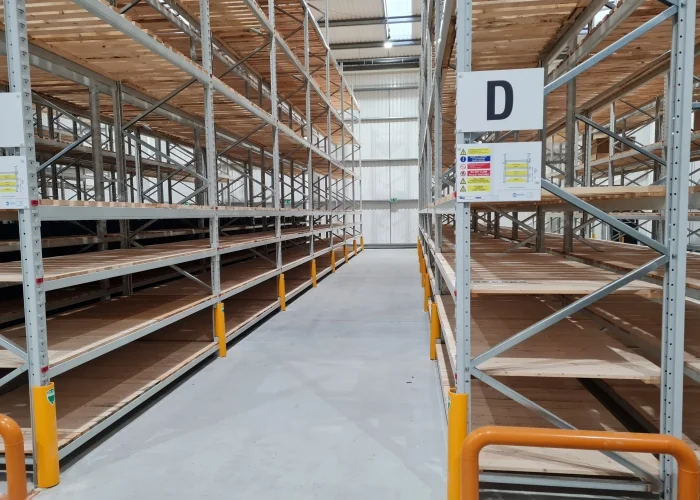
Moving components add inspection and maintenance requirements. Carts, wheels, stops and rails need to remain clean, aligned and undamaged. Debris, broken pallet boards or an impact can interrupt movement. Staff should report unusual resistance, noise, skewing or uncontrolled travel immediately rather than continuing to use the lane. Push-back also requires a higher initial equipment investment than simple adjustable racking because each lane contains engineered moving parts. That extra cost can be justified by the additional pallet positions and operational benefits, but it should be tested through a capacity and throughput comparison.
Push-back racking compared with other pallet systems
There is no single best system. Adjustable racking prioritises selectivity. Drive-in prioritises maximum density for large batches. Pallet flow prioritises rotation and separate loading and picking aisles. Push-back sits between these options, offering dense storage and face access with LIFO stock control. A hybrid warehouse is often more efficient than one system used everywhere. Fast-moving products with many pallet quantities may suit push-back. Slow-moving single pallets may stay in adjustable racking. Date-sensitive products may use flow lanes, while bulky long items require cantilever storage. The layout should follow the stock and handling data, not a preference for one product type.
When is push-back racking a good choice?
Push-back is usually worth considering when the warehouse holds several pallets per SKU, stock is stable enough to dedicate lanes, and LIFO handling is acceptable. It can work well for manufacturing buffer stock, drinks, packaged food with controlled batches, retail reserve stock and third-party logistics operations where client products are held in quantity. It is also useful where the business wants higher density but does not want forklifts travelling inside the rack. This can be valuable in busy operations where quick face loading and reduced rack-entry manoeuvring support productivity.How is the correct lane depth calculated?
The answer begins with pallet quantities by SKU. If most products are held in groups of three or four pallets, very deep lanes may not improve usable capacity. If core products are held in larger batches, deeper lanes may perform well, provided the chosen system and building height support them.The designer must also check roof height, sprinkler clearances, pallet load height, beam levels, aisle width and the lifting capacity of the truck at the highest position. A layout that adds positions on paper can fail operationally if the truck cannot place the load safely or if stock cannot be replenished at the required rate. Peak inventory is more important than average inventory. Seasonal businesses should model their busiest realistic stock level, while avoiding a design based on one exceptional week that creates inefficient empty lanes for the rest of the year.
Safe operation and inspection
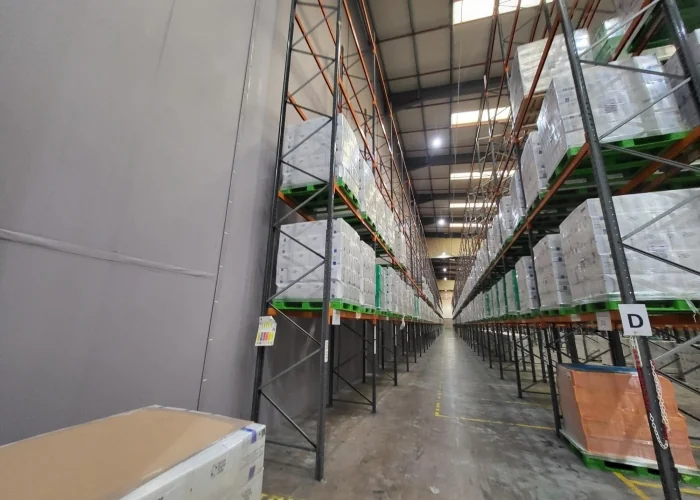
Push-back racking should be designed, installed and used for the loads shown on its load notices. Operators need system-specific instruction because the technique differs from placing a pallet on a static beam. The pallet should enter squarely, be supported correctly and be pushed only through the intended load sequence. Warehouse staff should report damage or abnormal movement as soon as it is seen. Regular recorded visual inspections and periodic expert inspections should include the structural frame, anchors, beams, carts, wheels, rails, rollers, stops and protective equipment. Damaged lanes should be isolated where required and repaired using components approved for the system. Unauthorised welding, drilling or mixing of parts can change the engineered capacity. Good housekeeping is particularly important. Loose stretch wrap, timber fragments and product debris can obstruct carts or rollers. A clear aisle also gives the driver the space needed to align the pallet without striking the rack.Planning a push-back racking project with Mowbray
A useful first stage is a warehouse survey combined with an inventory and movement review. Mowbray can measure the building, identify service and sprinkler constraints, review truck routes and compare the number of usable positions available from different layouts.The proposal should state the pallet specification, maximum load, lane depth, number of levels, rack protection, floor fixing assumptions and installation scope. It should also explain how the new system will be phased if the warehouse remains operational during the work.
A measured survey and stock analysis provide a more reliable answer than a generic capacity percentage. To discuss a layout, call Mowbray on 01572 827206, contact the Northern Office on 0113 403 1160 or email info@mowbrayltd.co.uk.
FAQs
- Is push-back racking FIFO or LIFO?
Push-back racking is normally LIFO. Pallets are loaded and removed from the same face, so the last pallet placed into a lane is the first one retrieved. Where strict FIFO or first-expiry-first-out rotation is required, pallet flow or another controlled method may be more appropriate.
- How many pallets deep can push-back racking be?
Many systems are designed for a small number of pallets per lane, often within a range such as two to six deep. The actual depth depends on the manufacturer, pallet, load, building and operational design. It should never be assumed from a generic figure.
- Can different products share one push-back lane?
They can physically fit, but mixing products usually removes the system's main operational logic because rear pallets cannot be selected independently. A lane is normally dedicated to one SKU or a clearly controlled compatible batch.
- Does push-back racking need special forklifts?
Not necessarily. Reach or counterbalance trucks may be suitable depending on the aisle, lift height and load. The truck capacity at height and the operator's ability to align the pallet must be checked during design.
- Is push-back racking more expensive than standard pallet racking?
The equipment cost per pallet position is generally higher because the lanes contain carts, wheels or rollers. The business case may still be stronger if the system creates substantially more usable positions or avoids the property cost of expansion.
- Can Mowbray inspect an existing push-back system?
Mowbray can discuss racking inspection, maintenance and alteration requirements. The inspection should identify the system and manufacturer where possible because moving components and replacement parts must be assessed against the original design.