






What Is Drive-In Pallet Racking?
Drive-in pallet racking stores pallets several deep with forklifts entering the lanes. Learn how it works, when to use it and its key safety requirements.

What Is Drive-In Pallet Racking?
Drive-in pallet racking is a high-density storage system in which a forklift drives into a rack lane and places pallets on continuous support rails several positions deep. By removing most access aisles, it stores more pallets in a given floor area than standard adjustable pallet racking. Traditional drive-in uses one entry point and normally operates last in, first out, making it best for large quantities of the same product with low stock-keeping-unit variety.
Drive-through racking is a related system with access at both ends of the lane. It can support first in, first out flow where pallets are loaded from one side and removed from the other. Both systems require consistent pallets, careful truck operation, floor anchoring and a layout designed around load, lane depth and stock rotation.
Mowbray designs, supplies and installs drive-in, VNA, adjustable and other pallet-racking systems across the UK. Comparing them through a measured layout helps identify whether density or direct access is more valuable to the operation.
Drive-through racking is a related system with access at both ends of the lane. It can support first in, first out flow where pallets are loaded from one side and removed from the other. Both systems require consistent pallets, careful truck operation, floor anchoring and a layout designed around load, lane depth and stock rotation.
Mowbray designs, supplies and installs drive-in, VNA, adjustable and other pallet-racking systems across the UK. Comparing them through a measured layout helps identify whether density or direct access is more valuable to the operation.
The rack manufacturer decides the anchor arrangement
The rack designer calculates or specifies the baseplate and fixing arrangement for the approved layout. This may include one or more anchors per footplate, particular hole positions, anchor diameters, embedment depths and installation torque. Different upright types or load cases can require different details within the same warehouse. The installation drawing and technical manual should be available to the contractor. If the racking has been moved and the original information is missing, a competent supplier should identify the system and assess it before new holes are drilled. Substituting anchor type, reducing the number or using an unapproved baseplate hole can change performance. Any variation should be authorised by the system designer.When drive-in racking is a good choice
Drive-in performs well where many pallets are held for each SKU and immediate access to every pallet is unnecessary. Common applications include cold stores, food and drink, raw materials, seasonal stock, manufacturing buffer storage and bulk products. Reducing aisles is especially valuable in temperature-controlled buildings where every cubic metre is expensive to construct and operate. It can also suit slow-moving reserve stock that is replenished or dispatched in batches. A lane can be assigned to one product, production run, best-before date or customer order. The system is less suitable where the warehouse holds one or two pallets of hundreds of different products. In that case, blocked access and partially filled lanes can reduce effective capacity.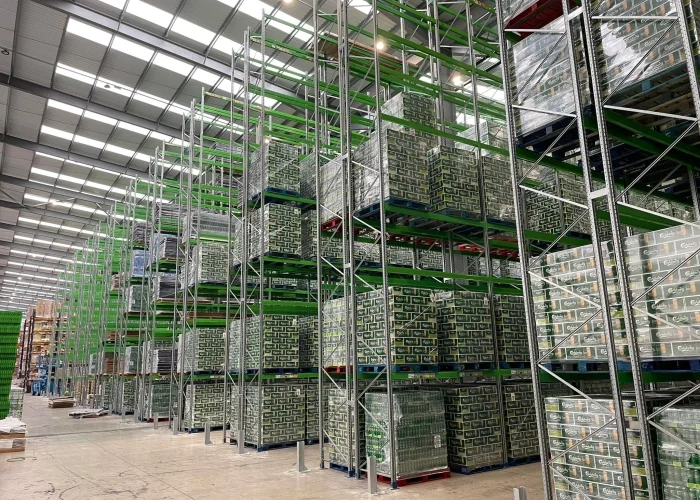
Storage density and lane utilisation
Drive-in can create a very dense block because several rack rows share one access lane. The theoretical pallet count may be impressive, but actual utilisation depends on stock discipline. If each lane must contain one SKU or batch, a half-empty lane cannot always be filled with unrelated stock without compromising rotation. The design should use real inventory data: pallets per SKU, batch sizes, dwell time and seasonality. A deeper lane increases density but also increases the number of pallets blocked behind the front position. Shorter lanes provide more flexibility but require more structural divisions and access faces. Capacity should be measured as usable positions at normal occupancy, not only the maximum number shown on a drawing.Pallet quality and compatibility
Pallets are structural interfaces in drive-in racking. They span between rails and must be the correct size, orientation, condition and load distribution. Broken boards, missing blocks, excessive deflection or inconsistent dimensions can cause a pallet to sit incorrectly or fall. The design should define the approved pallet types and maximum loads. Overhanging goods can strike uprights or prevent the truck from entering safely. Flexible sacks, drums or unstable loads may need additional support or another storage method. Incoming pallets should be inspected and unsuitable ones transferred before they enter the lanes. Good pallet control is more critical than in standard racking because the driver handles loads within the structure.
Forklift and aisle requirements
The truck must fit the lane with the required operating clearances and have sufficient capacity at the lift height. Counterbalance or reach trucks may be used depending on the design, but mast, overhead guard, cab, load and turning dimensions all need to be checked. Guide rails, floor markings or entry protectors can help alignment. The approach aisle must allow the truck to square up before entering; an angled or restricted entry increases impact risk. Drivers should enter slowly, avoid turning inside the lane and keep the load centred. Truck selection and rack design should be coordinated. Changing to a wider truck or larger load later can make the existing clearances unsafe.Structural design and floor fixings
Drive-in racking has fewer front beams tying the frames together than conventional selective racking and relies on a designed arrangement of top ties, bracing and lane components. The truck operates inside the structure, so impact risk is significant. HSE guidance states that drive-in and drive-through racking should always be fixed securely to the floor in accordance with the manufacturer’s instructions. The concrete slab must support the upright loads and anchors. Floor level affects rail alignment and truck clearance. Frames, rails and entry components need to be installed within the specified tolerances. No lane should be used until the system has been inspected, anchored, signed and handed over with the approved loads and operating sequence.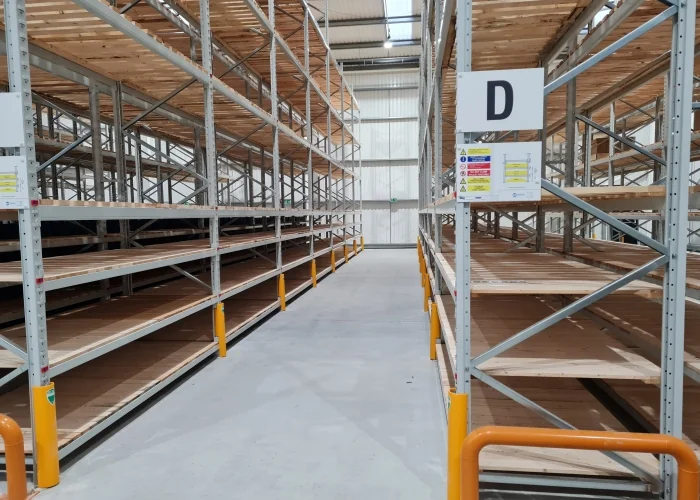
Loading and unloading sequence
A safe sequence maintains stability and stock rotation. Pallets are normally placed at the deepest available position before nearer positions are filled. Levels may be loaded in an order specified by the designer and operating procedure so the structure is not left with an unintended distribution of load. Drivers should lift the pallet clear of the rails, travel without dragging and lower it squarely. Pushing pallets along the rails or using one pallet to move another can damage loads and the rack. Retrieval should confirm that the path is clear and that no shifted pallet obstructs the lane. Warehouse management locations need to match physical lanes and depths so staff do not search inside the rack or break the rotation rule.Advantages of drive-in racking
The main benefit is high storage density. Fewer aisles can mean more pallet positions or a smaller temperature-controlled footprint. The system can provide simple batch separation and works with familiar forklift handling rather than powered mobile bases. Steel cost per pallet position can be attractive in a well-utilised block because lanes share structural components. The layout can also reduce travel between pallets of the same batch. For stable, consistent stock with many pallets per SKU, these advantages can outweigh the lack of direct access.
Limitations and operational trade-offs
Traditional drive-in is usually last in, first out, which may not suit dated or perishable stock unless batches are tightly managed. Access to inner pallets is blocked, and an urgent request can require front pallets to be moved. Part-filled lanes can reduce effective capacity. Forklift entry increases the likelihood of rack damage. Throughput may be slower because drivers need careful positioning and cannot pass each other inside a lane. The system is less flexible when pallet sizes or stock profiles change. These limitations do not make drive-in unsafe or inefficient; they mean it should be matched to the right inventory rather than selected only for maximum density.Drive-in compared with VNA and standard APR
Standard adjustable pallet racking provides direct access and high flexibility but uses more aisle space. VNA narrows those aisles while retaining direct access, at the cost of specialist trucks, tighter floors and greater system coordination. Drive-in removes even more aisles but sacrifices selectivity. A warehouse with many SKUs and frequent individual picks may favour APR or VNA. A cold store holding large batches of a few products may favour drive-in. Mixed warehouses can combine systems, using selective racking for fast movers and drive-in blocks for reserve stock. The comparison should include truck investment, throughput, usable occupancy and damage risk as well as pallet count.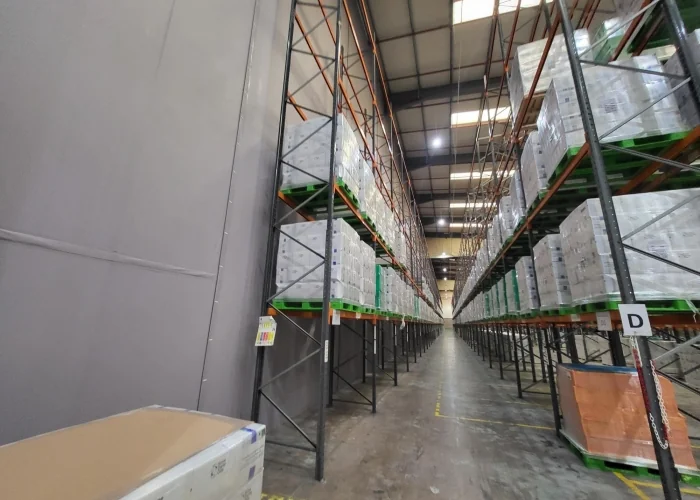
Safety, inspection and maintenance
Drivers need system-specific training and clear lane rules. Speed control, good lighting and unobstructed entry improve safety. Pedestrians should not enter active lanes, and climbing the rack is prohibited. Regular visual checks should focus on entry uprights, rails, brackets, floor fixings, top ties and any signs of twisting or impact. Staff must report damage immediately. A technically competent expert should inspect the system at intervals no greater than 12 months, with shorter intervals where risk justifies them. Damaged components should be unloaded and repaired using compatible approved parts. Site straightening or welding should not be improvised.Designing a drive-in project
The process begins with pallet and stock analysis. The designer needs load weight, pallet dimensions, pallets per SKU, rotation rules, throughput and peak occupancy. A building survey records height, columns, slab, doors, fire exits, sprinklers and approach aisles. CAD options test lane depth, levels and access. The selected forklift is checked against clearances and residual capacity. Protection, signage, anchors and inspection access are included before manufacture. Mowbray can compare drive-in with VNA, standard APR, push-back and other systems and coordinate installation with wider warehouse or mezzanine work.Is drive-in racking right for your operation?
Mowbray can survey the warehouse, assess the layout and floor, specify a suitable pallet-racking system and complete the installation with approved fixings, protection, load notices and handover documentation. Existing systems can also be inspected before alteration or relocation.It is a strong candidate when stock is consistent, batch sizes are large, density matters and last-in-first-out rotation is acceptable. Drive-through may be considered where first-in-first-out flow and access at both ends are practical. It is less suitable for highly varied, fast-pick inventory requiring immediate access to each pallet.
A measured survey and stock analysis provide a more reliable answer than a generic capacity percentage. To discuss a layout, call Mowbray on 01572 827206, contact the Northern Office on 0113 403 1160 or email info@mowbrayltd.co.uk.
FAQs
- Is drive-in racking FIFO or LIFO?
Traditional one-way drive-in is normally last in, first out. Drive-through access can support first in, first out where loading and retrieval occur from opposite ends and stock control follows that flow.
- How deep can a drive-in lane be?
Lane depth is project-specific. Deeper lanes increase density but reduce flexibility and increase blocked access. Pallet quantity per SKU, truck operation and structural design determine the practical depth.
- Can different products share one lane?
They can only do so under a controlled stock plan that preserves identification and retrieval. In practice, lanes are commonly dedicated to one SKU or batch because inner pallets are not directly accessible.
- Does drive-in racking need special pallets?
It needs pallets of the approved size, orientation, strength and condition. Standard pallets may be suitable if they meet the design, but damaged or inconsistent pallets should not be used.
- Is drive-in racking safe?
Yes, when correctly designed, installed, anchored, operated and inspected. Risk increases if trucks enter too quickly, pallets are unsuitable or damage is not reported. Training and regular inspection are essential.
- Can drive-in racking be converted to drive-through?
Not by simply opening the rear. The structure, bracing, access, stock flow and safety arrangements need redesign. A competent supplier should assess whether modification is feasible.