




Drive-In Racking in Bedford


Drive-In Racking in Bedford
Density is only valuable when it matches the stock profile. Lane depth, rotation method, pallet consistency, forklift clearances and replenishment frequency need to be tested together; otherwise a design with many theoretical locations can lose practical capacity through partly filled lanes and difficult access.

Where drive-in racking fits Bedford logistics operations
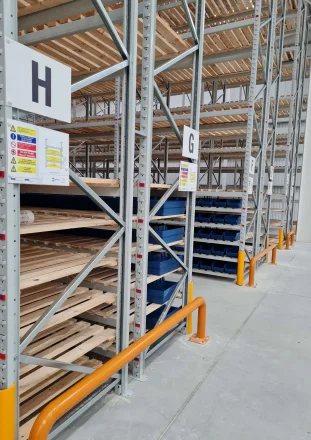
Bedford’s location between the M1 and A1 via the A421 makes the area attractive for distribution and production activities, and local commercial listings include high-bay warehouses with large yards and substantial floor loading. In these operations, the pressure is often not simply to store more pallets but to hold seasonal or batch stock without sacrificing every metre to access aisles. Drive-in can suit bulk reserve inventory, manufacturing buffers, packaging, food and drink lines with compatible rotation rules, or slow-moving pallet groups. It is less convincing when a Bedford warehouse carries hundreds of low-quantity SKUs that need immediate access, because deep lanes can become fragmented and under-used.The forklift becomes part of the racking system’s operating geometry. Mast width, overhead guard, turning approach, pallet overhang and driver visibility all need to suit the lane. In a busy Bedford distribution site, protection at lane entrances and a disciplined damage-reporting process are especially important because trucks repeatedly work close to uprights and rails. A useful comparison should model drive-in against adjustable pallet racking, push-back or narrow-aisle options using peak inventory and actual SKU quantities. The right answer is the system that creates the most usable locations at the required throughput, not the one with the highest density percentage on a sales drawing.

Where this solution is most useful
Typical applications include bulk production stock with several pallets per SKU, seasonal inventory held in batches, cold stores where cubic space is valuable, manufacturing buffer stock, and finished goods with compatible rotation rules. These uses do not all require the same specification. A room used by several people, a high-bay storage area and a secure technical enclosure may occupy a similar footprint but create very different structural, acoustic, fire, access and service requirements.Key design and specification decisions
Stock rotationSingle-entry drive-in lanes normally operate last-in, first-out. Drive-through designs can support first-in, first-out movement when loaded and retrieved from opposite sides, subject to operational control. A measured survey is especially important where older structures, later alterations or mixed floor levels make the available space less regular than the lease plan suggests.

Pallet dimensions, bottom boards, load stability and maximum weight must be compatible with the rails. Damaged or mixed pallets can create unsafe support and handling conditions.
Forklift and lane geometry
Truck width, mast, turning, lift height and operator visibility determine lane clearances. The vehicle must be selected and operated for the racking, not treated as an unrelated purchase. Where the building remains operational, installation logistics need to account for vehicle movements, protected pedestrian routes and safe temporary storage throughout the work.
SKU quantities and honeycombing
Deep lanes are productive when enough pallets of the same stock can fill them. Too many low-quantity SKUs create unusable empty positions behind unrelated stock.
Protection and inspection
Guide rails, floor markings, upright protection and disciplined impact reporting support safe operation. Structural damage inside lanes can be harder to see and needs planned inspection access.

Survey, design and installation process
A controlled project starts with a brief that records the business problem, the proposed use, capacity, constraints, target dates and who can approve decisions. Mowbray can then survey the property and develop options around the relevant structure, equipment, partitions, storage and finishes. The survey should be sufficiently detailed for the stage of the project and should identify information that still needs specialist verification. After the preferred option is selected, structural calculations, product specifications, service coordination, fire information, landlord requirements and statutory submissions can be completed as applicable. Installation planning should then cover deliveries, access, lifting, waste, noisy work, temporary routes, segregation and the point at which each area is safe to release for use.
Key design and specification decisions
Stock rotation
Single-entry drive-in lanes normally operate last-in, first-out. Drive-through designs can support first-in, first-out movement when loaded and retrieved from opposite sides, subject to operational control.
Pallet quality and consistency
Pallet dimensions, bottom boards, load stability and maximum weight must be compatible with the rails. Damaged or mixed pallets can create unsafe support and handling conditions.
Forklift and lane geometry
Truck width, mast, turning, lift height and operator visibility determine lane clearances. The vehicle must be selected and operated for the racking, not treated as an unrelated purchase.
SKU quantities and honeycombing
Deep lanes are productive when enough pallets of the same stock can fill them. Too many low-quantity SKUs create unusable empty positions behind unrelated stock.
Protection and inspection
Guide rails, floor markings, upright protection and disciplined impact reporting support safe operation. Structural damage inside lanes can be harder to see and needs planned inspection access.
Coordinating the complete space
The project may need to integrate adjustable racking for low-quantity SKUs; staging and marshalling areas; cold-store panels and refrigeration clearances; rack protection and traffic management; and load signage and inspection programmes. Treating these as connected packages reduces clashes and makes responsibility clearer. For example, a partition can affect ceiling support, ventilation and fire detection; racking can affect lighting and sprinkler clearances; a mezzanine can change routes, loads and services both above and below the new deck.
Compliance, safety and approvals
Pallet racking is work equipment and must be suitable for its intended use, installed correctly and maintained in a safe condition. HSE warehouse guidance emphasises competent design, correct use, damage reporting and inspection. Drive-in systems need particular control because forklifts enter the structure. Load notices, lane rules, pallet specification, clearances and repair methods must match the engineered design.
Safe use after handover matters just as much as safe construction. The occupier should retain the relevant drawings and limits, train users where necessary, keep routes clear, report damage or defects, and review risk assessments when the layout, load or work activity changes. A compliant installation can become unsafe if it is altered informally or used outside the declared design conditions.
What affects cost and programme?
There is no responsible fixed price for drive in racking in Bedford without knowing the site and specification. The principal variables are shown below. The lowest quotation may exclude surveys, approval support, protection, making good, service alterations, waste removal or out-of-hours work, so scope should be normalised before a decision is made.
Number of pallet positions and lanes - Changes the quantity, capacity or structural specification.
Rack height, depth and load capacity - Affects engineering, component selection and installation time.
Drive-in versus drive-through layout - Can add specialist products, coordination or testing.
Guide rails, protection and accessories - May require approvals, protection or altered sequencing.
Floor condition and fixings - Influences access, labour and disruption to the live site.
Installation phasing and stock relocation - Should be defined before quotations are compared like for like.
Where the wider project requires connected workspace or storage work, Mowbray can also coordinate warehouse fit out where those elements form part of the same coordinated scheme.
Why work with Mowbray?
To discuss drive in racking in Bedford, contact Mowbray on 01572 827206, the Northern Office on 0113 403 1160, or email info@mowbrayltd.co.uk. The resulting recommendation should be specific to the site; it should not rely on a generic city-page specification.
FAQs
- Is drive-in racking FIFO or LIFO?
A single-entry drive-in block is generally LIFO because the last pallet placed in a lane is the first one accessible. A drive-through arrangement with separate loading and retrieval faces can support FIFO, provided the stock process is controlled.
- How many pallets deep can a lane be?
Lane depth is project-specific. It depends on stock quantities, building depth, pallet and load quality, truck operation and manufacturer design. The goal is usable capacity, not the deepest possible lane. Related Mowbray guidance is available through pallet racking solutions.
- Is drive-in racking suitable for many SKUs?
Usually not when most SKUs have only one or two pallets. The system is most efficient for relatively few product lines held in larger batches. A mixed layout may place bulk lines in drive-in and other stock in adjustable racking. Related Mowbray guidance is available through storage solutions.
- Does the forklift need special guidance?
Guide rails or floor guidance may be used to support alignment and protect lower rack components. The exact arrangement depends on the truck, lane and risk assessment. Related Mowbray guidance is available through cantilever racking.
- Can existing drive-in racking be altered?
Alteration requires competent verification of the original system, components, loads and proposed configuration. Moving beams or mixing parts without design approval can invalidate capacity and safety assumptions. Related Mowbray guidance is available through shelving solutions.
- Does Mowbray provide inspections after installation?
Mowbray can discuss inspection, repair and maintenance requirements as part of a wider pallet-racking service. Day-to-day reporting, regular recorded checks and periodic expert inspection should form part of the user’s management system. Related Mowbray guidance is available through case studies.